
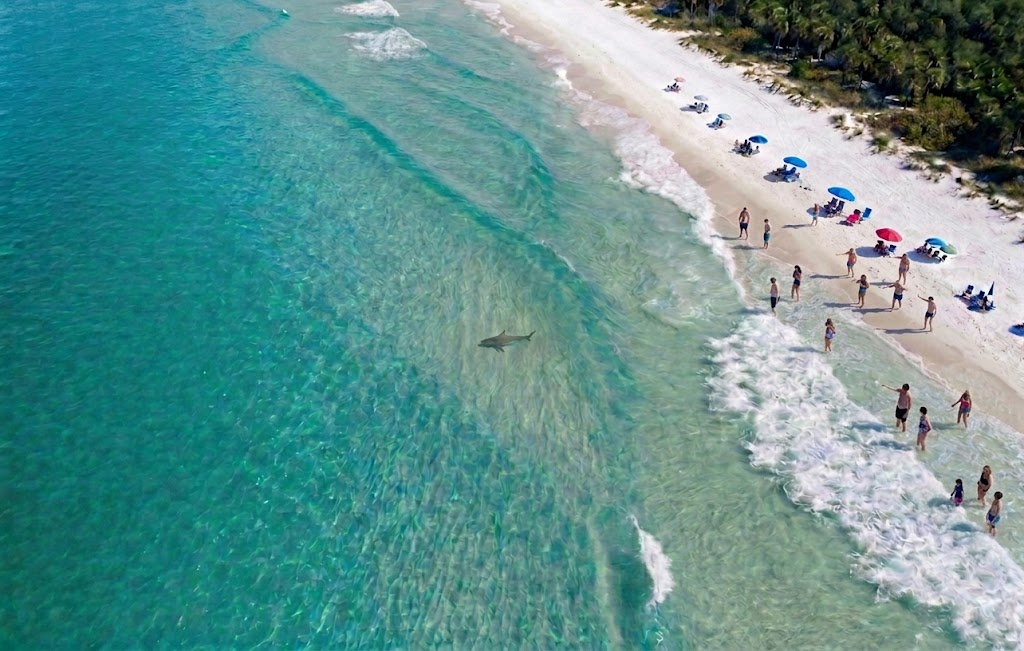
The Reality of Shark Attacks on Florida’s Emerald Coast and Highway 30A
The Reality of Shark Attacks on Florida’s Emerald Coast and Highway 30A
Introduction
Over the past 75 years, there have been shark encounters along Florida’s Emerald Coast, but the data shows the most of any year has been three, with the average being roughly one every three years. The three most serious attacks occurred along the 30A corridor in Walton County on June 7, 2024, approximately four miles apart and within 90 minutes of each other. It is not known if this was one rogue shark or coincidence. Sadly, two of the three victims suffered life-altering injuries. Elisabeth Foley, 45, lost her lower left arm after being attacked at Watersound Beach. Lulu Gribbin, 15, lost her left hand and right leg above the knee after being attacked at Seacrest Beach approximately 90 minutes later. A third victim sustained minor injuries.
June 8, 2026 — Panama City Beach (Bay County): A civilian employee at Naval Support Activity Panama City was attacked by a shark while swimming near the base’s marina in St. Andrew’s Bay during his lunch break. The man, in his late 20s, suffered serious injuries to both arms and was transported to a trauma hospital in critical condition. His name has not been released. As of this writing, no public update on his condition has been provided. Our thoughts are with him and his family. For ongoing coverage of 2026 shark activity along the Emerald Coast, see our detailed 2026 Shark Activity Report on Vacation 30A.
June 3, 2026 – a child sustained a superficial leg wound while standing in knee-deep water near the WaterColor beach access — a potential shark encounter that prompted South Walton Fire District to close five miles of coastline as a precaution. The cause has not been officially confirmed. The closure was lifted the following morning after lifeguards found no further threat. We keep this post updated as new incidents occur, and as a result of the 2024 attacks we examined historical records, analyzed frequency by year, broke down incidents by county, and identified the months most common for shark activity along the Emerald Coast.
Planning a trip to Florida’s Emerald Coast? Explore Things to Do on 30A and find the Best Time to Visit before you book.
An Overview of Shark Attacks Through History
Beachgoers frequently visit the Highway 30A region, a picturesque route that runs along the Gulf of America (formerly Gulf of Mexico), and the Emerald Coast, which stretches from Pensacola to Panama City and includes five counties – Escambia (Pensacola), Santa Rosa (Navarre), Okaloosa (Ft. Walton, Destin), Walton (30A and Miramar Beach), and Bay (Panama City) counties. Shark attacks do occur, although they are relatively uncommon. The number of shark attacks in this area that have been reported over the previous 75 years has varied annually as of June 2024. These incidents aside, the average year is relatively “shark free” in terms of injuries.
Emerald Coast Shark Attacks by Year (Since 1959)
After sifting through shark attack data*, separating provoked vs. unprovoked attacks, and eliminating incidents that go back into the 1700s, we decided to just review data since 1959 for this analysis. There were also encounters with sharks that resulted in no injuries, so that data was also removed. Lastly, zeroed in on just the Emerald Coast (Florida Panhandle) counties of Escambia, Santa Rosa, Okaloosa, Walton, and Bay counties in this dataset.
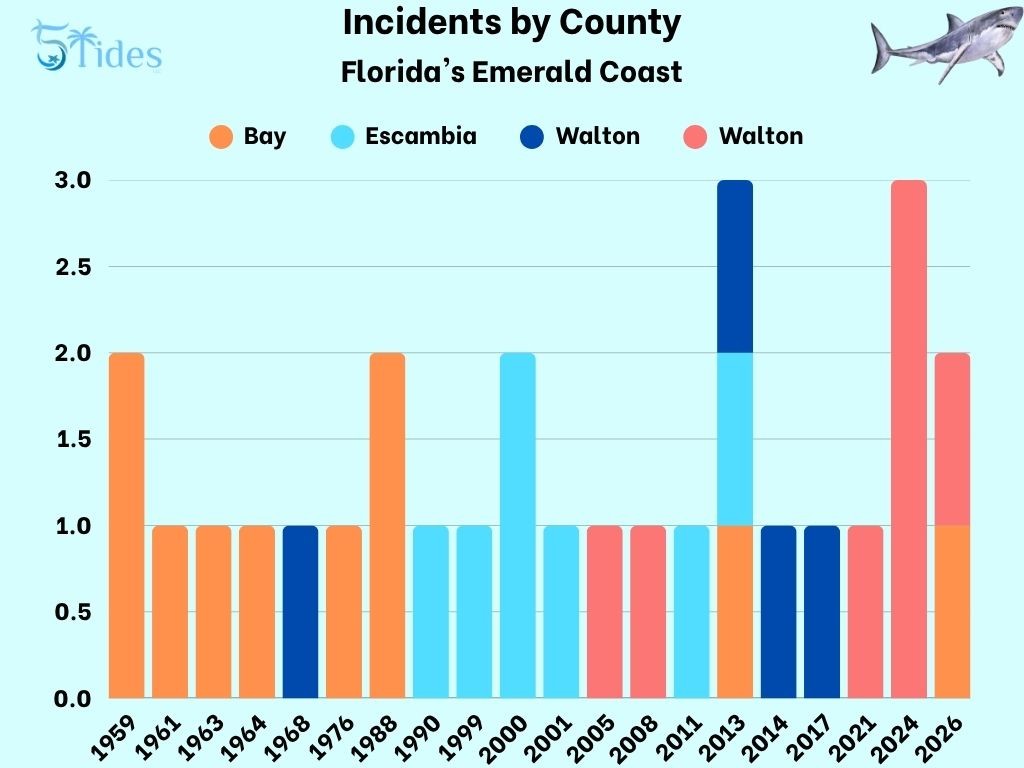
- This data shows 27 shark injuries since 1959 – a span of approximately 65 years. That is approximately one every 2.5 years.
- Of those injuries, three were fatal with the last one occurring in 2005 (Walton County).
- 2024 stands as the most significant year for shark attacks in recent Emerald Coast history. Three victims were injured on the same day within 90 minutes of each other — two suffering life-altering amputations. It remains an anomaly in the broader historical data and the most incidents recorded in a single year since 2013.
Shark Attacks by County in Florida Panhandle
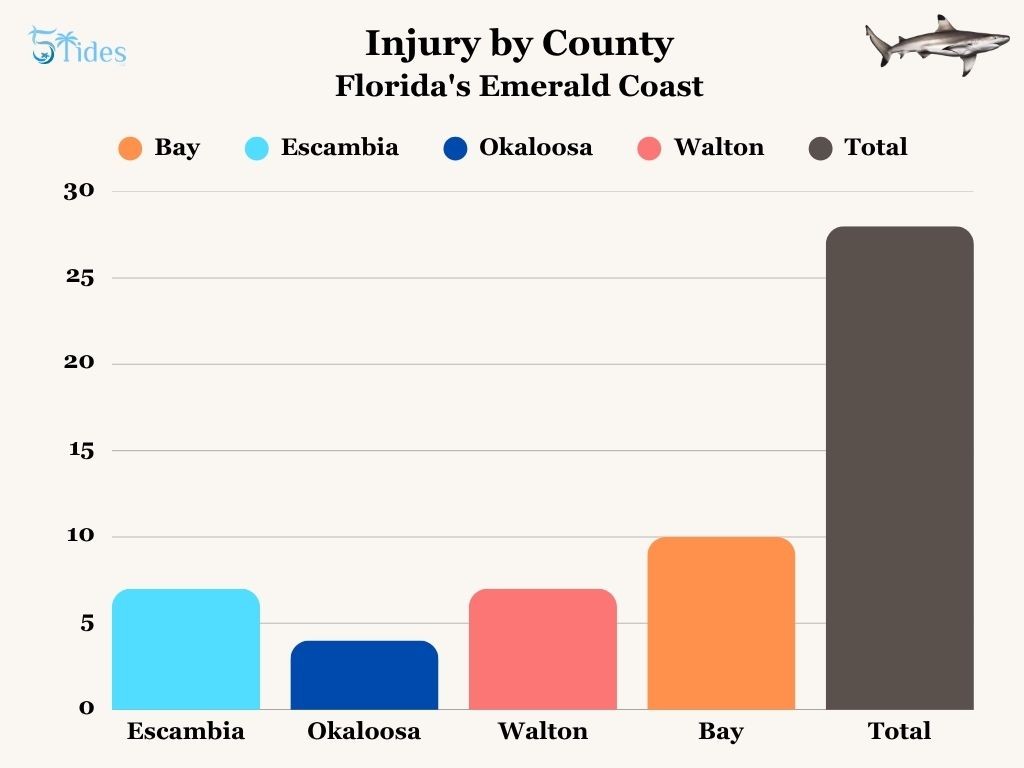
Here is the breakdown by County in the Emerald Coast (Florida Panhandle)
Shark Attacks by County Florida Panhandle
This data shows:
- Bay County – 10
- Escambia County – 7
- Walton County – 7
- Okaloosa – 4
- Total = 27
- There have been 3 fatalities – Bay – 2 (1959, 1988), Walton -1 (2005)
Frequency by Month for Emerald Coast
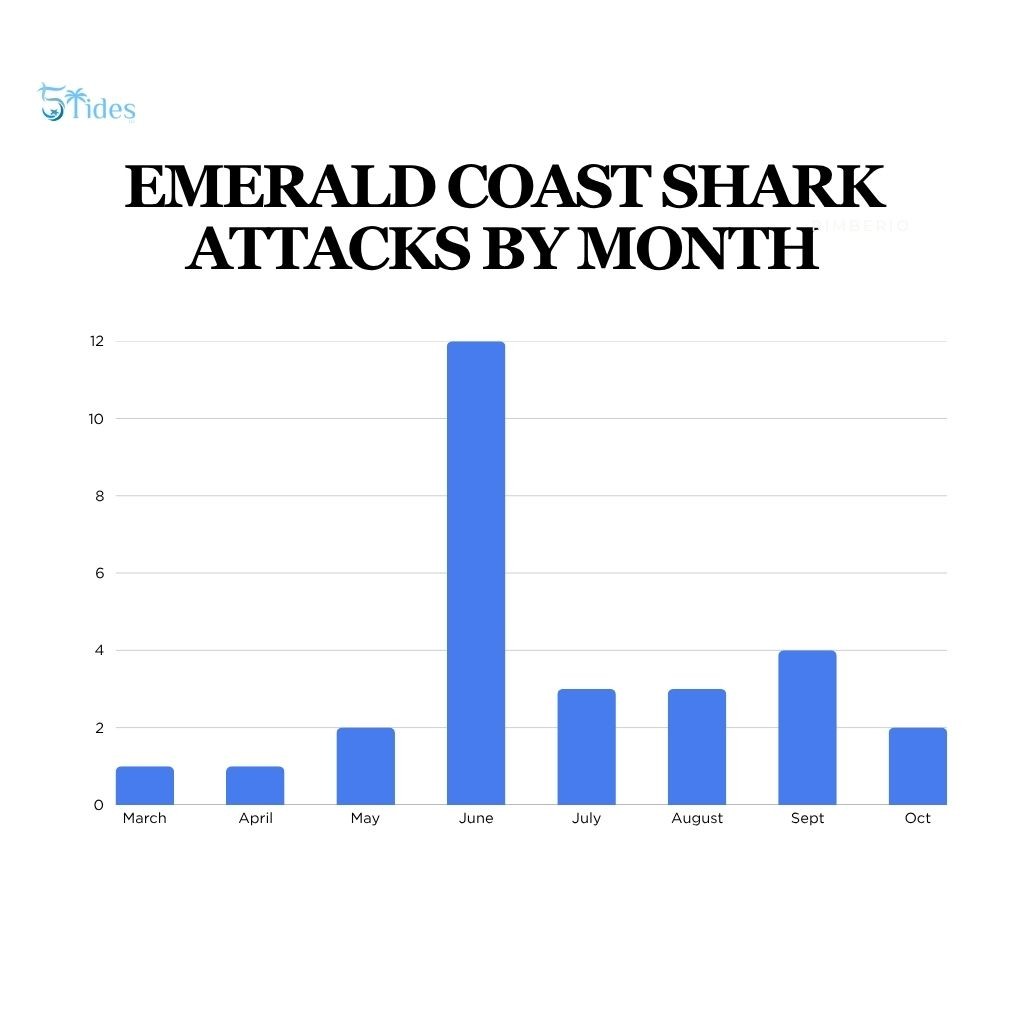
The summer months offer the most likelihood of a shark attack, but also features the most visitors to the Emerald Coast
- June is clearly the highest month, with 10
- September 4
- August and July: 3 each
Location of Shark Attacks in Walton County
The infographic below shows some of the locations along scenic Highway 30A
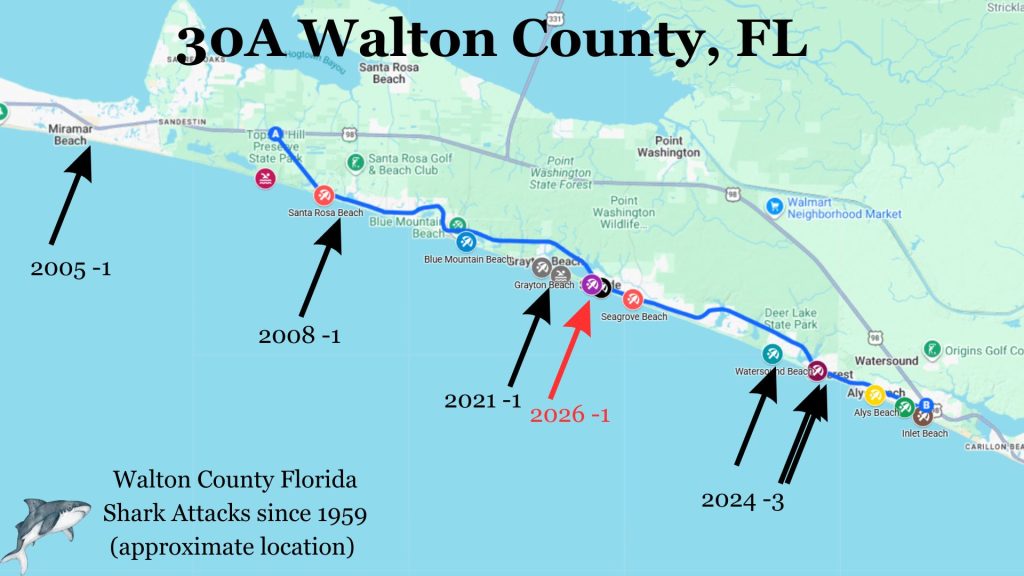
Walton County Map of Shark Attacks
With its twenty-eight mile stretch of picturesque beaches, 30A has seen very few shark attacks in its history. Even though these instances are worrying, the area receives millions of visitors annually.
- 2005: A fatal attack occurred at Miramar Beach, just west of where Highway 30A begins. This remains the only recorded fatality along the 30A corridor.
- 2008: A non-fatal attack was reported in the Santa Rosa Beach area.
- 2021: A non-fatal incident was documented at Grayton Beach, the first recorded encounter in over a decade.
- 2024: Three attacks occurred on June 7 near Watersound Beach and Seacrest Beach on the east end of 30A. Elisabeth Foley, 45, lost her lower left arm at Watersound Beach. Lulu Gribbin, 15, suffered the loss of her left hand and right leg above the knee at Seacrest Beach approximately 90 minutes later. A third victim sustained minor injuries. These remain the most severe attacks in the 30A corridor’s recorded history.
- 2026: On June 3, a child sustained a superficial leg wound in knee-deep water near the WaterColor beach access. South Walton Fire District responded by closing five miles of coastline between One Seagrove Place and Gulf Trace as a precaution, deploying drone surveillance and additional lifeguard coverage. No further marine life threat was identified and the closure was lifted the following morning. The cause has not been officially confirmed.
These incidents, while concerning, are remarkably rare given the millions of visitors who swim these waters every year. Understanding the patterns of shark activity along 30A — and respecting the beach flag system — allows beachgoers to enjoy one of the most beautiful coastlines in the world with clear eyes and reasonable confidence.
Lulu’s Law — A 30A Legacy That Changed National Beach Safety
The June 7, 2024 attacks on 30A had an impact far beyond the tragedy of that day. Lulu Gribbin, the 15-year-old attacked at Seacrest Beach who lost her left hand and right leg above the knee, refused to let her injuries define her future. Instead she became a national advocate for beach safety and the driving force behind landmark federal legislation.
Lulu’s Law — formally introduced in the U.S. Senate in March 2025 by Senator Katie Britt of Alabama — would require the Federal Communications Commission to issue wireless emergency alerts to beachgoers’ cellphones when a shark attack is confirmed nearby, functioning similarly to Amber Alerts or severe weather notifications. The alerts would use geolocation to reach all WEA-enabled mobile devices within a defined radius of a confirmed attack.
The legislation passed the U.S. Senate unanimously in July 2025 and cleared the full House of Representatives 401 to 6 on May 20, 2026 — and is now headed to President Trump’s desk for signature. Once signed, the FCC will be required to act within 180 days to implement the alert system.
The connection to 30A is direct and personal. Had a wireless alert system been in place on June 7, 2024, the beach closure order issued after the first attack at Watersound Beach could have reached Lulu and her friends at Seacrest Beach before the second attack occurred 90 minutes later. That gap in communication is exactly what Lulu’s Law is designed to close.
Lulu has continued her advocacy through the Lulu Strong Foundation, which she launched to support research and prosthetic technologies for amputees. Her story — born on the beaches of 30A — has now changed how the entire country will respond to shark attacks.
2026 Update – The Emerald Coast Remains One of the Safest Coastlines in America
In 2025, Florida recorded 11 unprovoked shark attacks statewide — topping the national list — yet the Emerald Coast and 30A corridor recorded zero incidents, continuing the region’s historically low encounter rate outside of the anomalous 2024 events. In 2026, a potential encounter near WaterColor on June 3 resulted in a superficial injury to a child in knee-deep water. The cause has not been officially confirmed, but SWFD responded with a precautionary five-mile closure that was lifted the following morning after no further threats were identified. It is a reminder that these waters are shared with marine life — and that the response system here works.
On the legislative front, Lulu’s Law — named for Lulu Gribbin, who was seriously injured in the June 2024 attacks just miles from here — passed both the U.S. Senate and House with overwhelming bipartisan support and is awaiting President Trump’s signature. Once signed, it will authorize local and state authorities to deploy geofenced wireless emergency alerts — similar to an Amber Alert — directly to beachgoers’ cell phones when a shark attack occurs or unsafe water conditions are present. That is a meaningful upgrade in public safety that did not exist before Lulu and her family fought for it.
Check live beach conditions before you head out at our 30A Beach Cams — including current flag status and water conditions.
Beachgoer Safety Advice
- Swim in Groups:
- Sharks are more likely to target solitary individuals. Swimming in groups reduces the risk of shark encounters.
- Avoid Swimming at Dusk and Dawn:
- These are peak feeding times for many shark species. Stick to swimming during daylight hours when visibility is better.
- Stay in Designated Swimming Areas:
- Lifeguards monitor these areas for shark activity and other dangers. Swimming in these zones is generally safer.
- Avoid Wearing Shiny Jewelry:
- Reflections from jewelry can resemble fish scales, potentially attracting sharks. Leave your shiny accessories on the shore.
- Don’t Swim Near Fishing Areas:
- Areas where people are fishing can attract sharks due to bait and fish in the water. Avoid swimming near piers or boats that are actively fishing.
- Avoid Entering the Water with an Open Wound:
- Sharks have a keen sense of smell and can detect blood from afar. If you have an open wound, it’s best to stay out of the water.
- Don’t Swim in Murky Water:
- Sharks can mistake you for prey in low-visibility conditions. Clear water allows both you and sharks to see each other better, reducing the likelihood of mistaken identity.
- Avoid Excessive Splashing:
- Splashing can attract sharks by mimicking the movements of distressed or injured prey. Try to swim smoothly and avoid unnecessary splashing.
- Be Cautious Around Sandbars and Drop-offs:
- Sharks often patrol these areas looking for food. Stay in shallower waters away from sudden drop-offs and sandbars.
- Follow Local Shark Advisories:
- Pay attention to local news, beach advisories, and signs about recent shark sightings or warnings. Lifeguards and local authorities provide valuable information about current conditions.
Make sure you have the right beach safety gear before heading out — see our Beach Essentials Guide for everything we recommend for Gulf Coast visitors including a NOAA weather radio and first aid essentials.”
In Summary
Shark attacks along Florida’s Emerald Coast and 30A may not happen frequently, but they do follow specific patterns that can help beachgoers stay safe and informed. By taking the appropriate precautions and being aware of when these attacks are most likely to occur, visitors may enjoy the gorgeous beaches in peace of mind. Remember that the ocean is a shared space and that treating its inhabitants with respect is necessary for harmonious coexistence.
Take in the beauty of 30A and the Emerald Coast, but use caution and due diligence.
- Public opendatasoft is the source used for this study
Take in the beauty of 30A and the Emerald Coast with confidence. Browse the 30A Events Calendar, explore Things to Do on 30A, or come stay with us at 5Tides right on Highway 30A in Santa Rosa Beach.
Cheers!
-5Tides
Subscribe to Our Blog


